 (213) 891-0909



Prices last reviewed September 2026. All figures are approximate US dollar ranges and are reviewed quarterly, since Rolex pricing moves every year.
A new Rolex starts in the $6,000s at US retail and climbs past $100,000 for gem-set gold models, with most steel sports and dress watches landing between roughly $8,000 and $17,000. On the pre-owned market, the same watches can sell below retail or at more than double the sticker price, depending on the model, condition, and demand.
That spread is exactly why "how much is a Rolex" doesn't have a single answer. A steel Oyster Perpetual and a gold Day-Date wear the same crown, but they live in completely different price worlds. Materials, complications, production volume, and collector demand all push the number in different directions.
This guide breaks down Rolex pricing model by model, explains the gap between retail and resale, and shows you how to judge whether a price is fair before you buy.
Retail Price vs. Market Price: The Two Numbers That Matter
Every Rolex has two prices. The first is retail, the suggested price Rolex sets for its authorized dealers. The second is the secondary market price, which is what the watch actually trades for between collectors, dealers, and buyers.
For many models, those numbers are close. For the most in-demand steel sports watches, they can be thousands of dollars apart. Authorized dealers often keep popular references on long waitlists, so buyers who want a watch now turn to the pre-owned market and pay whatever that market will bear.
It also cuts the other way. Some references, especially precious metal dress watches and older Datejust models, regularly sell below retail pre-owned. That makes the secondary market a smart place to shop, not just a last resort.
Time of Swiss is an independent pre-owned retailer, not an authorized dealer, so our pricing reflects the real secondary market for authenticated watches.
Why Rolex Retail Prices Keep Rising
Rolex raised prices across its catalog on January 1, 2026, the fourth straight year of increases. Steel models rose roughly 2% to 6%, while gold models saw steeper jumps of about 5% to 7%, driven largely by rising gold costs.
US buyers feel it more. Import tariffs on Swiss watches and a weaker dollar stack on top of the list-price increase, which pushed the steel Submariner No-Date (ref. 124060) past the $10,000 mark for the first time.
The takeaway: retail is a moving target. A watch that seemed expensive two years ago may look reasonable next to today's sticker, and that shift quietly lifts pre-owned values too.
How Much Is a Rolex by Model? 2026 Price Ranges
The table below shows starting US retail for each major collection alongside a typical pre-owned range for steel or entry configurations. Pre-owned ranges vary widely by year, condition, and whether the watch comes with its original box and papers.
|
Collection |
Starting US Retail (2026) |
Typical Pre-Owned Range |
Price Driver |
|
Oyster Perpetual |
About $6,400 |
$5,000 to $10,000 |
Dial color demand |
|
Datejust |
About $8,000 to $9,000 (steel) |
$5,000 to $17,000 |
Size, metal, bezel |
|
Explorer |
About $7,900 |
$7,500 to $10,000 |
Low hype, steady demand |
|
Air-King |
About $8,150 |
$7,000 to $9,500 |
Niche appeal |
|
Submariner |
About $10,050 |
$10,000 to $16,000 (steel) |
Date vs. no-date, bezel color |
|
Explorer II |
About $10,600 |
$9,000 to $13,500 |
Dial color |
|
GMT-Master II |
About $11,800 |
$15,000 to $28,000 (steel) |
Bezel colorway |
|
Sea-Dweller |
About $14,550 |
$12,000 to $16,000 |
Tool-watch buyers |
|
Cosmograph Daytona |
About $16,900 |
$28,000 to $40,000 (steel) |
Waitlists, dial variant |
|
Sky-Dweller |
About $17,750 |
$16,000 to $25,000 |
Metal, complication |
|
Day-Date |
About $40,000 and up |
$20,000 (older) to $60,000+ |
Gold price, dial, gems |
Ranges are approximate as of September 2026 and will change. Contact us for current pricing on a specific reference.

Shop: Browse our authenticated pre-owned Rolex collection
Entry-Level Rolex Watches: Under $10,000
Oyster Perpetual
The Oyster Perpetual is the most accessible current Rolex. It's a time-only watch in sizes from 28mm to 41mm, powered by modern in-house movements with roughly 70 hours of power reserve. Standard dials trade near retail, while bright colors like turquoise or pink have historically commanded premiums.
Datejust and Explorer
The Datejust is Rolex's volume model, available in more configurations than any other collection. Steel versions with smooth bezels start under $10,000 at retail, and older references like the 116200 or 16200 can be found pre-owned for considerably less.
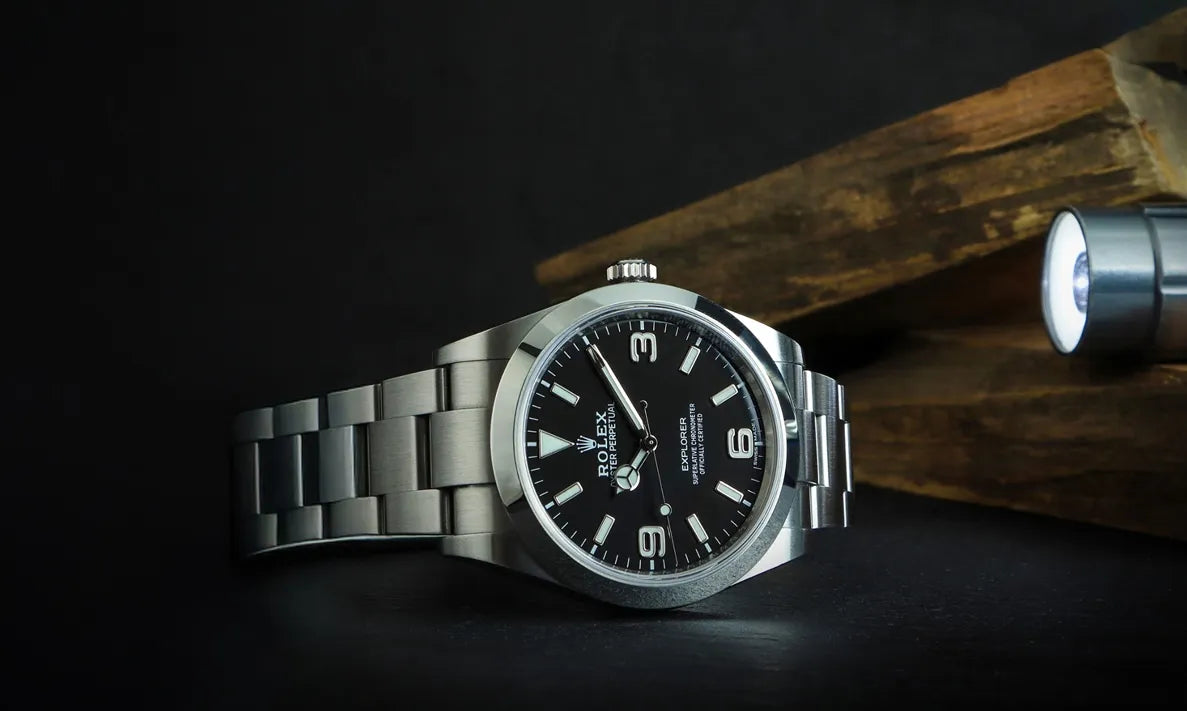
The Explorer 36 (ref. 124270) delivers genuine sports-watch DNA at one of the lowest prices in the lineup, and its market value sits close to retail.
Shop: Explore Rolex watches under $10,000
Mid-Range Rolex: The Steel Sports Watches
This is where the gap between retail and resale gets interesting.
The Submariner is the benchmark luxury dive watch. Retail sits just above $10,000 for the no-date and around $11,350 for the black Submariner Date, while green-bezel and discontinued references often trade well above that.
The GMT-Master II carries some of the widest premiums in the catalog. Steel models retail near $11,800, yet the blue and red "Pepsi" configuration has traded at more than double that on the secondary market.
The steel Cosmograph Daytona (ref. 126500LN) is the headline example. It retails around $16,900, but pre-owned steel Daytonas regularly change hands in the $30,000s.
Read more: Rolex movement types explained
Luxury Tier: Gold, Platinum, and Gem-Set Models
Once you step into precious metals, prices climb quickly. A two-tone Rolesor Submariner Date retails near $18,900, while the full yellow gold version runs close to $48,600.
The Day-Date, available only in gold or platinum, starts around $40,000 at retail and rises well past $70,000 with diamond bezels or stone dials. Gold Daytonas range from roughly $40,000 on an Oysterflex strap to over $140,000 for baguette-set versions.
The upside for buyers is that many precious metal models trade below retail pre-owned. A lightly worn Day-Date can represent serious savings compared with a new one.

What About Vintage and Discontinued Rolex Watches?
Vintage pricing follows its own rules. A well-worn 1970s Oyster Perpetual or Datejust can cost less than a new Oyster Perpetual, while rare references with original dials and documented provenance can reach six figures at auction.
Modern discontinued references sit in between. Watches retired in the last decade, like the ceramic Submariner 116610 generation or the previous Daytona 116500LN, still wear like new watches but carry prices shaped by collector demand rather than a Rolex price list.
With these watches, originality matters more than age. Replaced dials, service hands, and heavily polished cases can cut value dramatically, so documentation and a trusted dealer's inspection are worth more here than anywhere else in the market.
What Drives the Price of a Rolex
Materials
Oystersteel is the entry point, Rolesor (steel and gold) sits in the middle, and 18k gold or platinum sits at the top. Gold models typically cost four to five times their steel counterparts.
Complications
A time-only Oyster Perpetual costs far less than a Sky-Dweller with an annual calendar and dual time zone. Chronographs like the Daytona and GMT functions add both cost and demand.
Supply and Demand
Rolex doesn't publish production numbers, but popular steel sports models are consistently hard to get at authorized dealers. That scarcity is what pushes secondary market prices above retail.
Discontinuation
When Rolex retires a reference, prices often jump. The green Submariner "Hulk" (ref. 116610LV) and the white gold "Smurf" both saw strong secondary market gains after being discontinued in 2020.
Condition and Completeness
Original box, papers, and warranty card add real value. So do unpolished cases, original parts, and documented service history. A "full set" can command thousands more than the same watch sold on its own.
Read more: How often you should service a Rolex
Is a Rolex a Good Investment?
Rolex watches generally hold value better than almost any other luxury watch brand, and some references appreciate substantially. That said, not every model is an investment.
The secondary market peaked in 2021 and 2022, then corrected sharply before stabilizing. Buyers who paid peak prices for steel sports models saw values fall. Today's market is more rational, which is good news for buyers who want fair pricing.
If long-term value matters to you, focus on proven references, complete sets, and original condition. Buy the watch you want to wear first, and treat any appreciation as a bonus.
Read more: Why watches are a smart investment
How to Know You're Paying a Fair Price
Start by checking the reference number, production year, and what's included. Compare similar examples, not just the same model name, since dial variants and bracelet types can swing value significantly.
Always buy from a seller who authenticates every watch. Counterfeits have become extremely convincing, and a price that looks too good to be true usually is. A reputable dealer will verify serial numbers, movement, and parts before listing.
If you can't find the exact reference you want, a sourcing service can track it down for you. Time of Swiss has been authenticating and sourcing pre-owned luxury watches in Los Angeles since 1990.
Shop: Source a specific Rolex through Time of Swiss
Finding the Right Rolex for Your Budget
So, how much is a Rolex? Plan on the $6,000s to about $17,000 for most steel models at retail, $15,000 to $40,000 for in-demand sports watches on the secondary market, and $40,000 and up for gold and platinum. The right number depends on the model you want, how quickly you want it, and how much the box and papers matter to you.
Pre-owned gives you more options on both ends: discounts on dress watches and precious metals, and immediate access to steel sports models that would otherwise mean years on a waitlist.
Sell or Trade Your Watch If you're looking to sell your luxury watch or find out what it's worth, Time of Swiss offers free, no-obligation evaluations. Get started here.
How Much Is a Rolex: Common Pricing Questions
What is the cheapest Rolex you can buy?
The Oyster Perpetual is the least expensive current Rolex, starting in the $6,000s at US retail.
Pre-owned, older Oyster Perpetual and Datejust references can cost even less. The Explorer 36 is the most affordable current sports model.
Why are some Rolex watches more expensive pre-owned than new?
High demand and limited authorized dealer supply push secondary market prices above retail.
Models like the steel Daytona and GMT-Master II are difficult to buy new without a long wait. Buyers who want one immediately pay a premium on the pre-owned market.
Do Rolex prices go up every year?
Rolex has raised retail prices every January for the past four years.
Increases usually fall between 2% and 7%, with gold models rising the most. Past increases don't guarantee future ones, but the trend has been consistent.
Is it cheaper to buy a pre-owned Rolex?
Often yes, especially for dress watches and precious metal models.
Many Datejust, Day-Date, and Sky-Dweller references trade below retail. Popular steel sports models are the exception and usually cost more pre-owned.
Where can I buy an authentic pre-owned Rolex?
Time of Swiss in Los Angeles offers authenticated pre-owned Rolex watches backed by more than 30 years of experience.
Every watch is inspected before sale, and our team can source specific references that aren't currently in stock. Visit our showroom at 640 S Hill St or call (213) 891-0909.