 (213) 891-0909


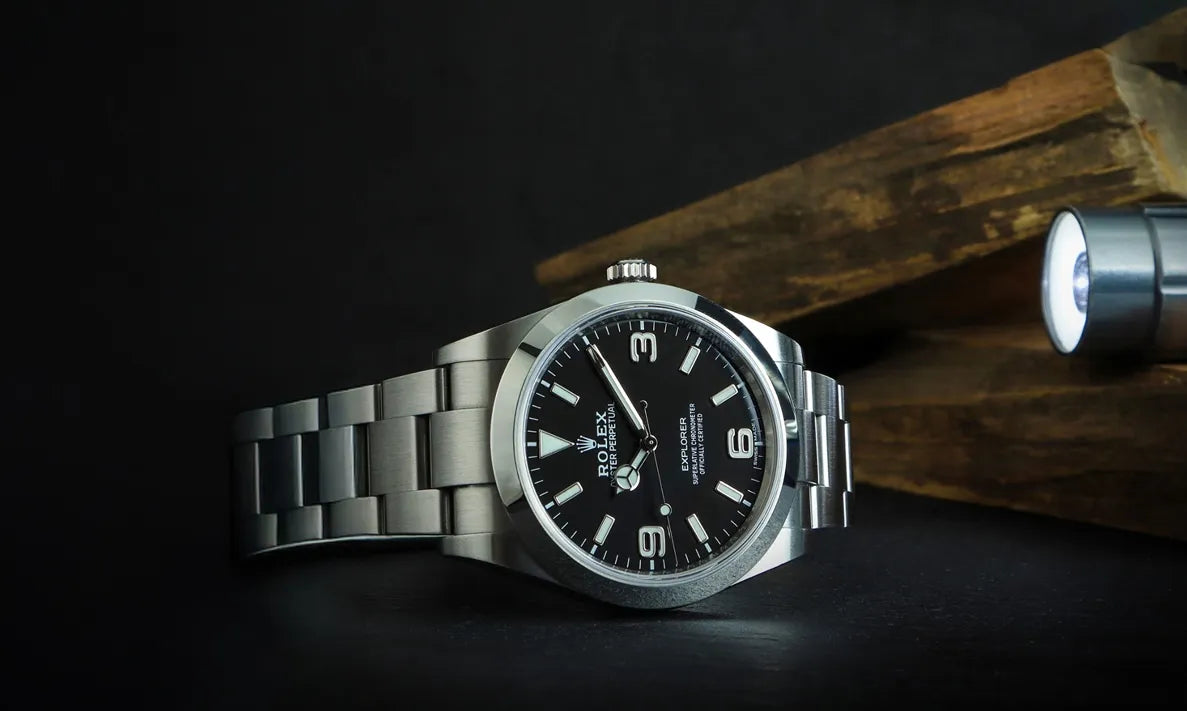

The Rolex Cosmograph Daytona meteorite dial is a dial face cut from a genuine iron-nickel meteorite, most commonly the Gibeon meteorite recovered in Namibia, then acid-etched and polished to reveal its natural crystalline structure. Because that structure formed over millions of years in space and cannot be replicated on Earth, every single meteorite dial Rolex produces is visually unique.
That combination, a racing chronograph with roots at Daytona International Speedway wearing a dial older than the planet, is why these references sit in a category of their own. They are not limited editions in the formal sense, but production has always been constrained by the material itself, and they have never been offered in steel.
This guide covers where the material comes from, how Rolex works it, which references matter, and what actually drives value on the secondary market.
IMAGE SUGGESTION: Extreme macro of a meteorite watch dial showing interlocking crystalline Widmanstatten lines in silver-grey metal, with a polished gold applied hour marker in frame, dramatic side lighting, no text overlay
What a Meteorite Dial Actually Is
Metallic meteorites are fragments of asteroid cores that broke apart millions of years ago. They are composed primarily of iron and nickel, and as they drifted through space they cooled at an almost incomprehensibly slow rate, on the order of a few degrees Celsius per million years.
That slow cooling allowed nickel-iron crystals to grow into long, interlocking bands. Cut the material into a thin slice and treat it with acid, and those bands become visible as a geometric lattice known as the Widmanstatten pattern, named after the naturalist Alois von Beckh Widmanstatten.
The pattern cannot be manufactured. No industrial process on Earth can replicate the cooling conditions required, which is precisely why it carries the weight it does with collectors. Two dials cut from the same meteorite slab will still show different arrangements.
You can also feel the difference. Where a standard Daytona dial is perfectly smooth lacquer, a meteorite dial retains a faint surface texture from the etching. It is subtle in photos and obvious in the metal.
Explore our pre-owned Rolex Daytona collection to see how meteorite compares against lacquer and stone dials in person.
From Namibia to the Wrist: How Rolex Makes Them
The raw material is believed to come primarily from the Gibeon meteorite, a large iron mass that fell in what is now Namibia somewhere in the range of 13,000 to 30,000 years ago. It is an octahedrite, meaning it has the specific crystal structure that produces well-defined Widmanstatten banding.
Rolex cuts the mass into thin sections, then polishes each slice, then chemically etches it to bring the pattern forward. The dial is then finished with applied gold hour markers, a gold coronet, and gold sub-dial borders, always matched to the case metal.
The failure rate matters here. Meteorite is brittle, prone to fracturing along its own crystal boundaries, and unforgiving during machining. Every dial that cracks during drilling or finishing is scrapped. That waste is a real part of why these references cost what they do and why volumes have never been high.
Rolex has applied meteorite to the Day-Date, the Datejust, the Pearlmaster, and the GMT-Master II over the years, including a white gold Pepsi GMT in 2019. The Daytona remains the most sought-after platform for it.
A Short History of Meteorite on the Daytona
Meteorite first appeared on the Daytona roughly two decades ago, in precious metal references with Roman numeral markers. Those early dials used matching meteorite sub-registers, which made for a beautiful but low-contrast face that could be genuinely hard to read in poor light.
The modern era began at Watches and Wonders 2021, when Rolex introduced a full wave of meteorite Daytonas across all three golds. Reference 116519LN paired 18k white gold with a black Cerachrom bezel and an Oysterflex bracelet. References 116508 in yellow gold and 116505 in Everose came with gold bezels and gold Oyster bracelets. All ran the calibre 4130.
The key change from the earlier generation: black chronograph registers. Setting dark sub-dials against the pale crystalline dial created a panda-style contrast that solved the legibility problem and, frankly, looked better.
Those references were discontinued within a few years, and the Rolex Cosmograph Daytona meteorite dial briefly disappeared from the catalog entirely. It returned quietly in 2025 as part of a batch of seven Daytona references Rolex added to its website without a formal announcement.
IMAGE SUGGESTION: Three luxury gold chronograph watches arranged in a row on dark grey stone, one white gold, one yellow gold, one rose gold, each with pale textured dials and black ceramic bezels, studio lighting, no text overlay
The Current Generation: 2025 References
The 2025 return brought the meteorite dial back in all three golds, but this time every version uses a black Cerachrom bezel and an Oysterflex bracelet rather than gold bracelets. That is a meaningful shift in character: the whole lineup now reads sportier than the 2021 wave.
|
Reference |
Case Metal |
Bezel |
Bracelet |
Movement |
|
126519LN |
18k white gold |
Black Cerachrom |
Oysterflex |
Cal. 4131 |
|
126518LN |
18k yellow gold |
Black Cerachrom |
Oysterflex |
Cal. 4131 |
|
126515LN |
18k Everose gold |
Black Cerachrom |
Oysterflex |
Cal. 4131 |
|
116519LN |
18k white gold |
Black Cerachrom |
Oysterflex |
Cal. 4130 |
|
116508 |
18k yellow gold |
Yellow gold |
Oyster |
Cal. 4130 |
|
116505 |
18k Everose gold |
Everose gold |
Oyster |
Cal. 4130 |
These current references carry all the updates Rolex rolled out to the Daytona in 2023. The case measures 40mm across and roughly 11.9mm thick, with slimmer lugs than the previous generation. The ceramic bezel insert now sits inside a metal frame. Hour markers are slimmer, and the sub-dial layout was refined.
Mechanically, the move from the calibre 4130 to the 4131 brought a 72-hour power reserve, a redesigned oscillating weight, and Rolex's Chronergy escapement. The chronograph layout is unchanged: 30-minute counter at 3 o'clock, 12-hour counter at 9, running seconds at 6.
Read more: Rolex movement types explained

How It Compares to Rolex's Other Stone Dials
Meteorite is not the only exotic dial material in the Daytona lineup. Rolex has produced lapis lazuli, sodalite, grossular garnet, and mother of pearl variants in precious metal cases, some with diamond markers.
The difference is category. Lapis and sodalite are minerals: rare, beautiful, terrestrial. Mother of pearl is organic. Meteorite is the only one that is extraterrestrial in origin, and it is the only one where the visual signature is a record of a physical process, the slow cooling of an asteroid core, rather than simple pigmentation.
That distinction matters more to collectors than it might sound. Stone dials tend to be valued on color and rarity. Meteorite is valued on the story and the fact that no two examples are the same.
Read more: What is the best color for a Rolex watch
Why It Commands a Premium
Three demand drivers stack up on this configuration at once. First, the Daytona name, which is already the most requested modern Rolex chronograph. Second, precious-metal-only production in modest volumes, with several references now discontinued. Third, a dial that literally cannot be duplicated.
Add the fact that these have historically been near-impossible to buy at retail. Authorized dealer allocation for gold Daytonas is tight to begin with, and meteorite variants sit near the top of that queue. For most buyers, the secondary market is not the fallback option, it is the only option.
The result is that a Rolex Cosmograph Daytona meteorite dial typically trades well above its retail figure, often by a wide multiple in the case of the white gold references. Market values shift constantly with demand, gold prices, and supply of clean examples, so treat any number you find as a snapshot rather than a fixed value.
One practical note: because these are high-value references, condition, originality, and documentation carry more weight here than on a standard Daytona. A polished case or a service-replaced dial affects value far more sharply at this level.
Explore our recent arrivals at Time of Swiss for current precious metal Daytona availability.
What to Check Before You Buy
Meteorite dials attract counterfeits and aftermarket swaps, so a few checks are worth making.
Pattern depth. A genuine dial has a physical, etched texture with visible depth. Printed imitations look flat under angled light and lack the faint tactile grain.
Pattern uniqueness. If you see two examples of the same reference with visually identical dial patterns, at least one is wrong. Real Widmanstatten banding varies from slice to slice.
Marker and hand metal. Rolex always matches the applied markers, hands, and sub-dial rings to the case metal. White gold markers on an Everose case is a red flag.
Paperwork and reference match. Confirm the reference on the papers matches the case, the bezel type, and the bracelet configuration. Aftermarket dial swaps into non-meteorite cases do happen.
Any reputable dealer should be able to walk you through all four without hesitation.
Where to Buy an Authenticated Meteorite Daytona
Time of Swiss has dealt in pre-owned luxury Swiss watches from our downtown Los Angeles showroom since 1990. We are an independent retailer, not an authorized dealer of any brand, which means we can offer discontinued and hard-to-source references that never appear on a retail waitlist.
Every watch we sell is independently authenticated and thoroughly inspected by our experts before it reaches the floor. If the specific reference you want is not currently in stock, our watch sourcing service can track it down through our network.
You are also welcome to visit the showroom and handle the piece before committing. With a meteorite, that matters more than usual. Photographs genuinely do not convey the surface.

Is a Meteorite Daytona Right for You?
If you want a Daytona that reads as a tool chronograph from three feet away and reveals something extraordinary up close, this is the configuration to chase. It is expensive, hard to find, and demands more diligence than a standard reference, but it is also the rare luxury purchase where the phrase "one of one" is literally accurate.
This is not the loudest watch Rolex makes. It is simply the only one where the dial has been forming since before the solar system settled into place.
Sell or Trade Your Watch If you're looking to sell your luxury watch or find out what it's worth, Time of Swiss offers free, no-obligation evaluations. Get started here.
FAQs About the Rolex Cosmograph Daytona Meteorite Dial
Is the Rolex Daytona meteorite dial real meteorite?
Yes. Rolex cuts these dials from genuine iron-nickel meteorite, most commonly the Gibeon meteorite found in Namibia.
The slab is sliced thin, polished, and acid-etched to reveal the Widmanstatten crystal pattern formed during millions of years of slow cooling in space. It is not a coating, print, or simulated texture.
Why is every meteorite Daytona dial different?
The crystalline structure varies naturally throughout the meteorite, so every slice produces a different pattern.
This is the core appeal for collectors. Two watches with the same reference number will have visibly different dials, which makes each one genuinely unique in a way almost no other production watch can claim.
Does Rolex make a steel Daytona with a meteorite dial?
No. Meteorite dials have only ever been offered in precious metal Daytona cases: white gold, yellow gold, and Everose gold.
There has never been a factory steel meteorite Daytona. Any steel example you encounter has an aftermarket dial and should be avoided if authenticity matters to you.
Which meteorite Daytona reference is the most collectible?
The white gold references, 116519LN and the current 126519LN, tend to draw the strongest collector demand.
Their black Cerachrom bezel and Oysterflex bracelet give the pale dial maximum contrast, and white gold's understated look appeals to buyers who want the rarity without the visual weight of yellow or rose gold. Everose examples run a close second.
Where can I buy a pre-owned meteorite Daytona in Los Angeles?
Time of Swiss in downtown Los Angeles stocks authenticated pre-owned Rolex Daytona references, including precious metal and hard-to-find dial configurations.
Every piece is verified by our experts before sale, and we can source specific references on request. Browse our authenticated Rolex collection or contact the showroom to discuss availability.